Things to do in Orlando for adults beyond the theme parks
Orlando has a lot to offer adults besides the parks. If you want a night with a story, two objects you made by hand, and a photograph worth keeping, here is where to start.
Orlando has painting studios, escape rooms, and dinner shows. The Crimson Curtain is none of those things. Here is what happens when a girls' night steps inside a scripted fictional world instead.
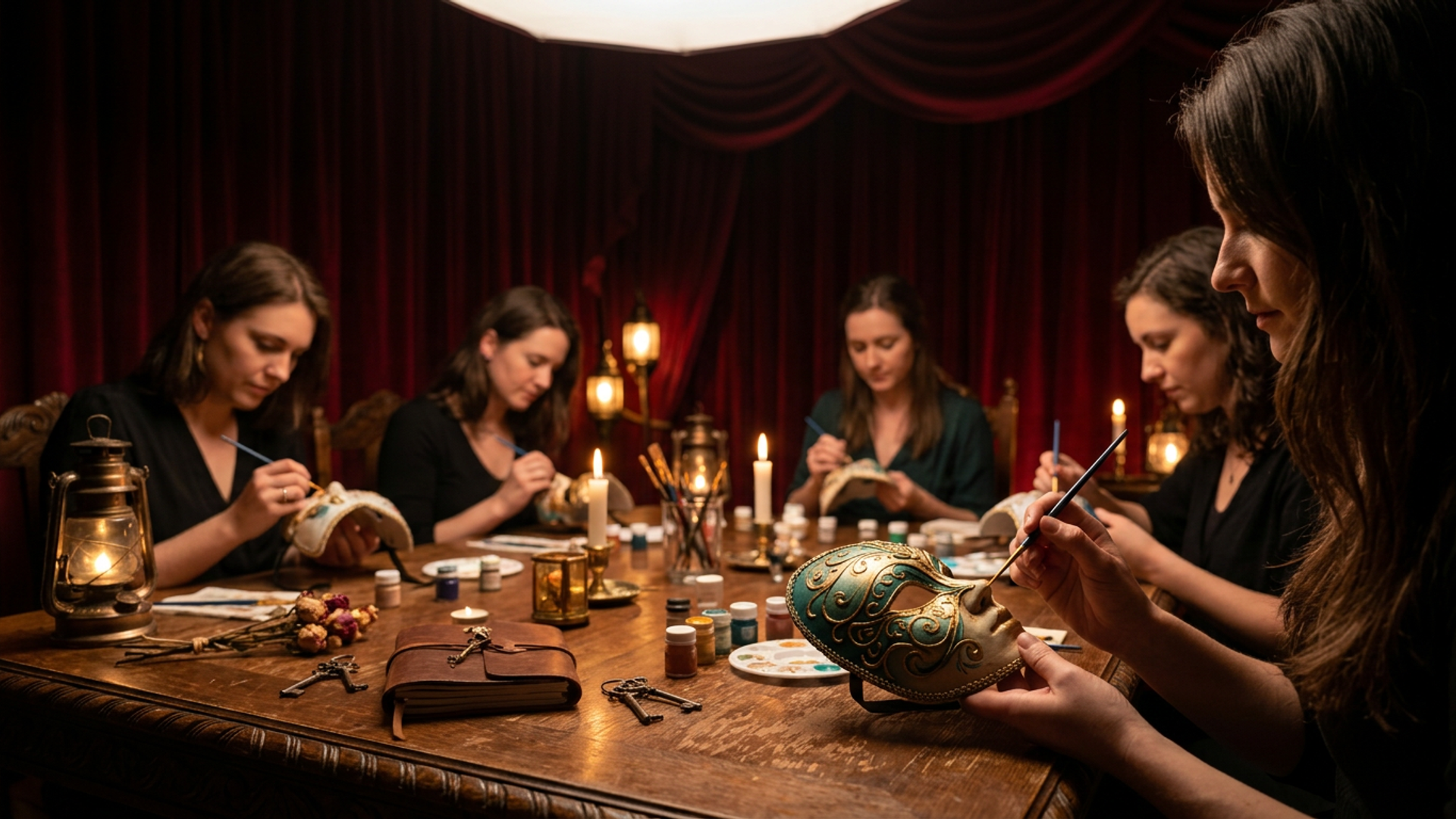
If you are planning a girls' night in Orlando and the usual list is starting to feel like a set of closed doors, you are not alone. The options are real but narrow: another painting evening, another escape room countdown, another dinner where the actors perform at the table while the group sits and watches. The Crimson Curtain at The Gilded Scene is built for the night after you have exhausted all of those.
It is a scripted world. Ninety minutes. Two handcrafted keepsakes. A professional photograph from a stage designed to be worth keeping. It runs once a month, and when that world closes, it does not reopen.
The Crimson Curtain is immersive craft theater. That phrase carries three specific things at once.
A live actor opens the evening and carries the narrative inside a studio dressed as a fictional place: crimson drapes, candlelight, dark wood, in-world materials at every table. Your group is not watching a performance. You are inside one.
During the ninety minutes, each guest completes two keepsakes by hand. A painted night mask. A sealed star bottle. Neither requires prior craft experience. Both are built for the current world's aesthetic, so they read as objects from a fictional place rather than souvenirs from a class.
The evening closes on the Crimson Curtain stage: a set piece built and lit with practical sources to produce a photograph that holds up on a phone screen, in a group chat, framed on a shelf.
Tickets are $72 per person, with a minimum of eight guests for a public night.
See the current world and claim a seat
Painting studios are designed to be repeatable. Every session is another painting evening, same canvas, same order, same wall to put it on afterward. The social content from Tuesday looks like the content from the Tuesday before, because the format requires that.
Escape rooms put puzzle-solving at the center. For groups where some guests are less competitive, or where the point of the evening is not a countdown clock, the format has a ceiling. There is no keepsake. The ending is a yes or a no.
Dinner shows are passive by design. The actors perform; the table watches. Making nothing, inhabiting nothing, leaving nothing.
The Crimson Curtain was built for the seam between all three: a guided narrative with no competitive stakes, craft outputs that are genuinely specific to the night, and a photo moment built into the structure rather than added as an afterthought.
The Crimson Curtain stage closes every evening. It was not designed as a backdrop. It was designed as a photograph: practical lighting, warm shadow, deep blacks, specific composition.
A professional photographer delivers the image digitally before the group leaves. This is the frame the group sends in the chat, shares on their feeds, and returns to when someone asks what they did that night. It looks like a still from something. Because the stage was built to make it look that way.
The Persona Kit, pre-ordered at booking, adds gloves, a brooch or pocket watch, and a character card with a fictional backstory for the current world. It lifts the photograph substantially. Guests who want to arrive already in partial character order it before they come; it is not available at the door. The kit is priced between $18 and $22 per person depending on the world.
If your group is five, six, or seven people and the public minimum feels like a barrier, the private buyout resolves it.
Your World, Your Night closes the studio to the public and opens it only for your group, up to twelve guests, at a flat rate starting at $650. It includes no shared seating, a custom welcome card printed with the group name, and a dedicated host for the entire evening. The Crimson Curtain experience runs exactly as it does on a public night, except the room belongs entirely to you.
Groups who can commit to twelve guests and want the studio to themselves, without the social calculus of shared seating, almost always book this option for milestone birthdays.
The person who chooses the evening carries the night's success personally. A failed outing is not just disappointing; it is a story the group tells about the organizer's judgment.
The Crimson Curtain was built with this in mind. The structure is guided from the moment the group sits down. The actor carries the narrative; the organizer does not manage logistics. The keepsakes come out of a designed process. The photograph happens at a designated moment. There is nothing to coordinate on the night because the world handles that.
The birthday guest or the organizer who found this and booked it is the one who discovered the cool thing first. That matters. It is part of what the evening gives back.
Is there a dress code for a girls' night at the Crimson Curtain?
No dress code. The Persona Kit, pre-ordered at booking, adds gloves and a character accessory for guests who want to arrive in partial character. It is optional but it lifts the stage photograph.
What if our group is smaller than eight people?
The public Crimson Curtain night requires a minimum of eight guests. For groups of five to twelve, the private buyout holds the entire studio at a flat rate starting at $650, with no minimum headcount restriction and no shared seating with the public.
Does everyone craft together or separately?
Each guest completes their own keepsakes at the table: a painted night mask and a sealed star bottle, both specific to the current world's aesthetic. The process is guided; no prior craft experience is needed.
How far in advance should a group book?
The Crimson Curtain runs once a month and seats are limited by studio occupancy. Three to four weeks is the reliable window. Private buyout dates move faster than public seats.
More from the studio
Orlando has a lot to offer adults besides the parks. If you want a night with a story, two objects you made by hand, and a photograph worth keeping, here is where to start.
Orlando has escape rooms, painting studios, and dinner shows. The Gilded Scene fits none of those categories. Immersive craft theater is something specific: a scripted world, objects you make by hand inside it, and a professional photograph to carry out.